Upload Code to Arduino From Another Arduino
Introduction
It is possible to concatenation Arduinos together in such a way as to get communication between the two. Having Arduino-Arduino communication can exist useful for many projects, such as having 1 Arduino to run motors and having some other sense the surroundings and and so relay commands to the other Arduino. This can exist done in several methods, using I2C and Serial, to listing a few.
This tutorial will focus on Arduino-Arduino communication through the serial ports (RX and TX).
Schematic
The schematic below shows how to connect the two Arduinos together. This shows two Unos, only if a Mega is used, it can be connected to any of the Serial ports on the Mega as long equally that is accounted for in the code.
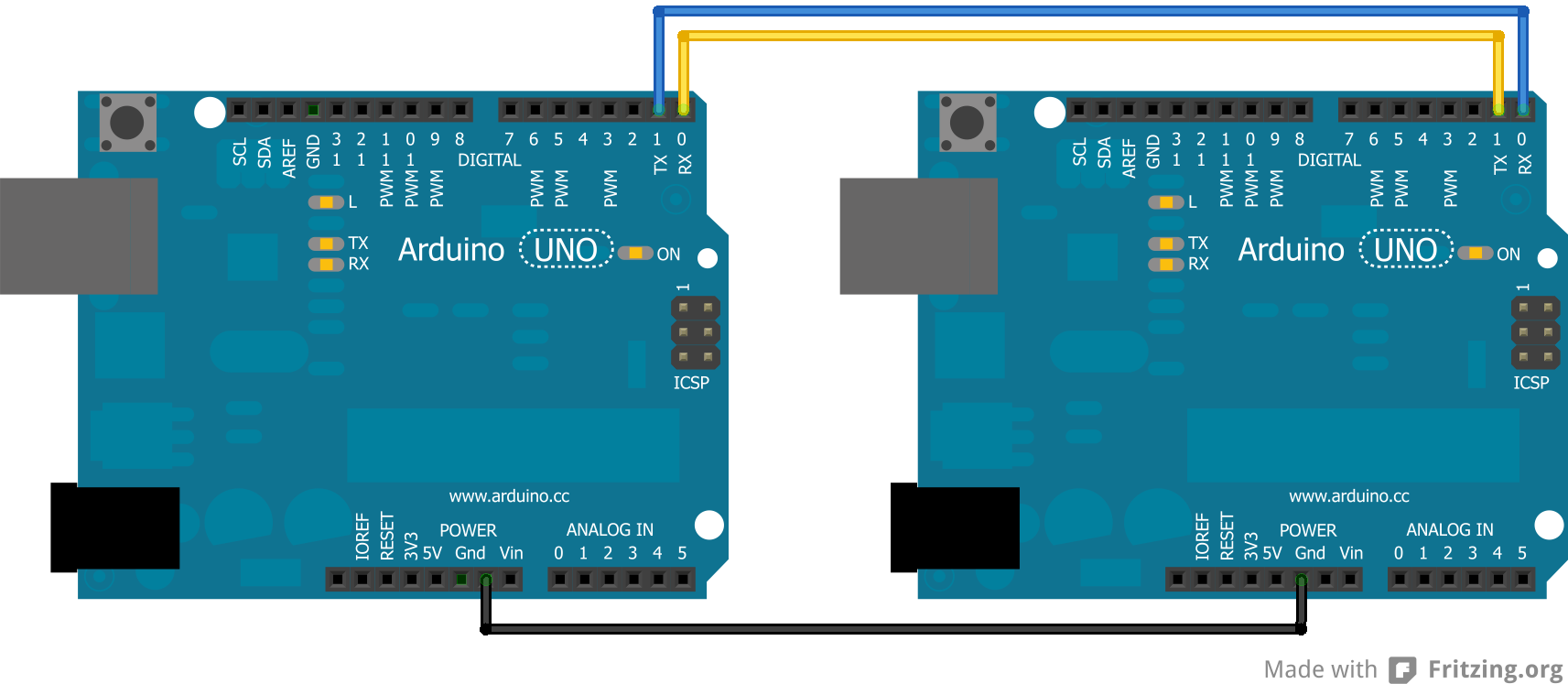
There has to be a common ground between the ii or else it volition not role properly. Also, notation that TX goes to RX and RX goes to TX.
Coding
When sending things through serial, everything is sent in bytes. These bytes are and so read one byte at a time past the other Arduino. When it is just characters existence sent through the serial, it is relatively easy to convert from characters to bytes. Still, if there are both characters and numbers are going through, this can atomic number 82 to messing up the data because a number and a character tin can have the aforementioned byte value, but that does not make them the aforementioned. Numbers are also tricky because they may non actually fit in the byte.
Simple Code
The easiest mode to get around this is to endeavour to avoid using characters and numbers at the same time. This tin exist done past sending one character beyond, each with a unlike significant. A good instance of this comes from the Arduino Physical Pixel tutorial.
Upload the Physical Pixel lawmaking, which can be found in the Arduino IDE under: File >> Examples >> Communication, onto 1 Arduino.
On the other Arduino, upload:
void setup() {
          Series.brainstorm(9600);
}void loop() {
            Series.print('H');
            delay(grand);
            Series.print('Fifty');
            filibuster(grand);
}
When this is run, the LED attached to Pin 13 on the Arduino with the Physical Pixel code should wink on and off at a frequency of 0.5 Hz. To make sure this is actually the code doing that, the delays can always exist inverse in the to a higher place lawmaking.
In this code the job of 'H' was to plough an LED on and the chore of 'L' was to turn the LED off. This tin easily be applicable to getting various characters triggering more reactions.
However, depending on the application, this may not exist enough and more drastic lawmaking may be required.
Complex Code
For sending data from one Arduino to another in a grade that cannot be simplified, at that place are other options. I option is to turn everything sent from the Sender Arduino into characters and then have the Receiver Arduino read in the characters. The data is really sent equally bytes, but the Arduino tin catechumen from characters to bytes and vice versa.
Sender Code
The sender code changes characters into bytes and, if necessary, information technology changes number values into characters before turning it into bytes. Below is a sample of the Sender code:
//Sender Codechar str[4];
void setup() {
Serial.begin(9600);
}void loop() {
int value=1234; //this would exist much more exciting if information technology was a sensor valueitoa(value, str, 10); //Turn value into a graphic symbol array
Series.write(str, 4);
}
Receiver Lawmaking
The receiver will then receive the byte array from the other Arduino and translate it in that location. Beneath is the code for the receiver. Note that this code is intended for a Mega since it will interpret the data received from the other Arduino and then print to the Series Monitor what information technology received and then that the user can cheque it. This debugging can be avoided by using an Uno and then press what was institute onto an LCD screen that uses I2C communication.
//Receiver Lawmakingchar str[4];
void setup() {
Serial.brainstorm(9600);
Serial1.begin(9600);
}void loop() {
int i=0;if (Serial1.available()) {
delay(100); //allows all serial sent to be received together
while(Serial1.available() && i<four) {
str[i++] = Serial1.read();
}
str[i++]='\0';
}if(i>0) {
Series.println(str,iv);
}
}
In that location is i flaw with this program equally it is now. It results in just a character array, and so if the integers were desired, they are lost without farther work on the data.
Further tutorials have been fabricated to show how this information may be manipulated by splitting strings or getting floats from the character arrays.
Source: https://robotic-controls.com/learn/arduino/arduino-arduino-serial-communication
0 Response to "Upload Code to Arduino From Another Arduino"
Enviar um comentário